Air Conditioner Buying Guide India — How to Choose the Right AC
Tonnage, star rating, split vs window, condenser and installation — the full decision guide for buying an AC in India, with the running-cost maths worked out.
Buying an AC in India comes down to a handful of decisions. Get one wrong and you pay for it every month, for the next ten years.
This guide works through each decision in order of how much it costs you. Tonnage first, because it matters most. Then star rating, form factor, condenser and installation.
Every running-cost figure here uses one baseline: a 1.5 ton inverter split AC at ₹8 per unit. Assume 8 hours a day, cooling to 24°C. Tables that differ say so.
1. Tonnage — Match It to Your Room or Regret It
Tonnage is cooling capacity. An undersized AC runs flat out and never reaches your set temperature. An oversized one short-cycles, leaving the room cold but clammy.
Both waste electricity. Both shorten the compressor's life. This is the one decision worth spending ten minutes on.
Start with room size
These figures assume standard conditions: a 10-foot ceiling, a middle floor, average insulation, no direct afternoon sun.
| Room Size (sq ft) | Recommended Tonnage | Typical Room |
|---|---|---|
| Up to 100 | 0.8 Ton | Small study, single occupancy |
| 100–120 | 1.0 Ton | Compact bedroom, home office |
| 120–150 | 1.0–1.5 Ton | Standard bedroom |
| 150–180 | 1.5 Ton | Master bedroom, medium living room |
| 180–220 | 1.5–2.0 Ton | Large bedroom, living room |
| 220–280 | 2.0 Ton | Large living room, open-plan space |
| 280–350 | 2.0–2.5 Ton | Very large hall (may need two units) |
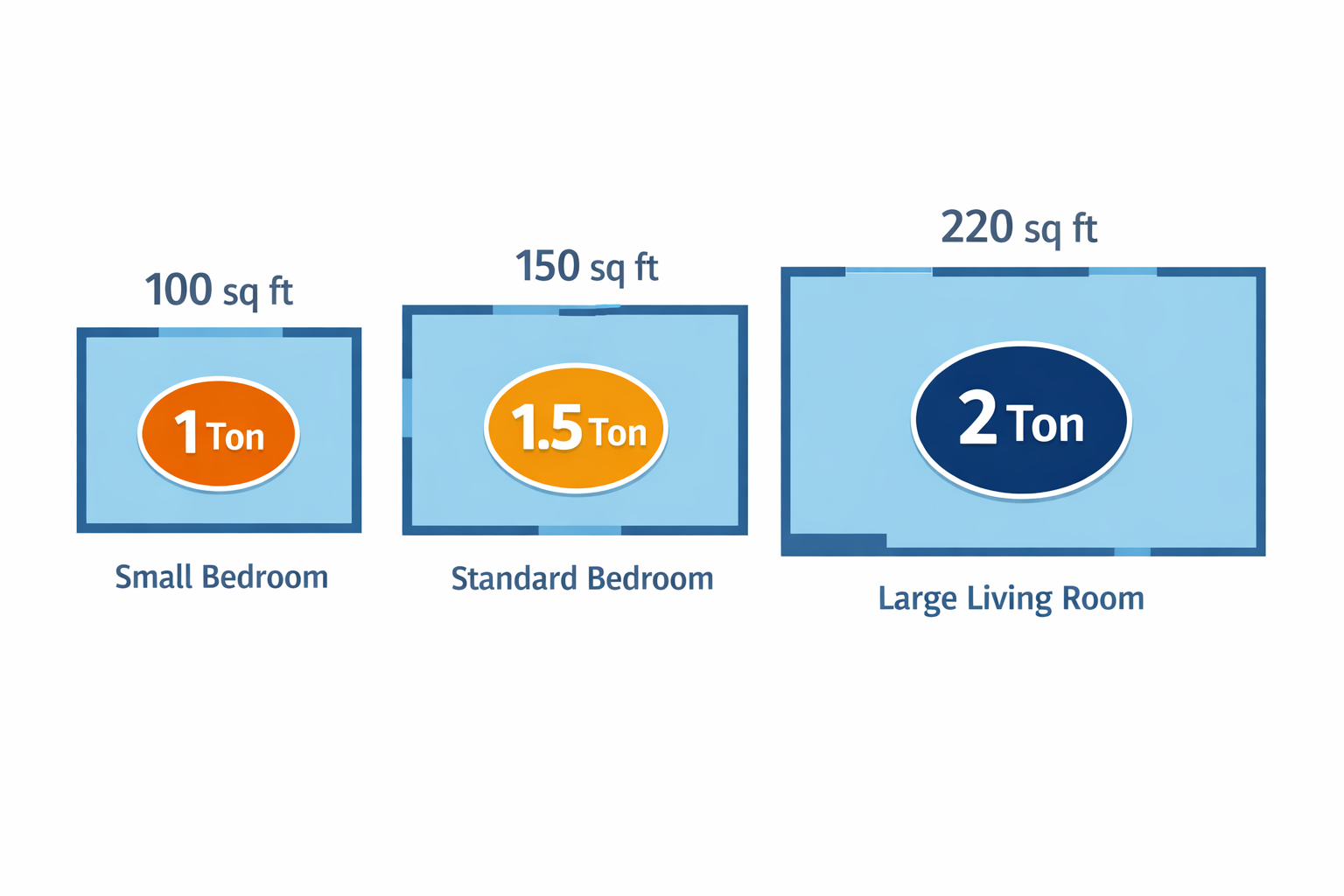
Measure length in feet, multiply by width. A 12 ft × 15 ft room is 180 sq ft.
If your room falls between two brackets, the four factors below decide which way you go.
Floor level — the most underestimated factor
Heat rises, and a top floor absorbs solar radiation straight through the roof. That adds 20–30% to the cooling load.
| Floor Level | Adjustment | Why |
|---|---|---|
| Ground floor | Standard or -10% | Often shaded, cooler ground contact |
| Middle floors | Standard | Insulated above and below by other floors |
| Top floor | +20–30% (size up 0.5 ton) | Direct roof heat, especially in concrete buildings |
| Top floor, no false ceiling | +30–40% (size up 0.5 ton minimum) | The RCC slab radiates heat straight into the room |
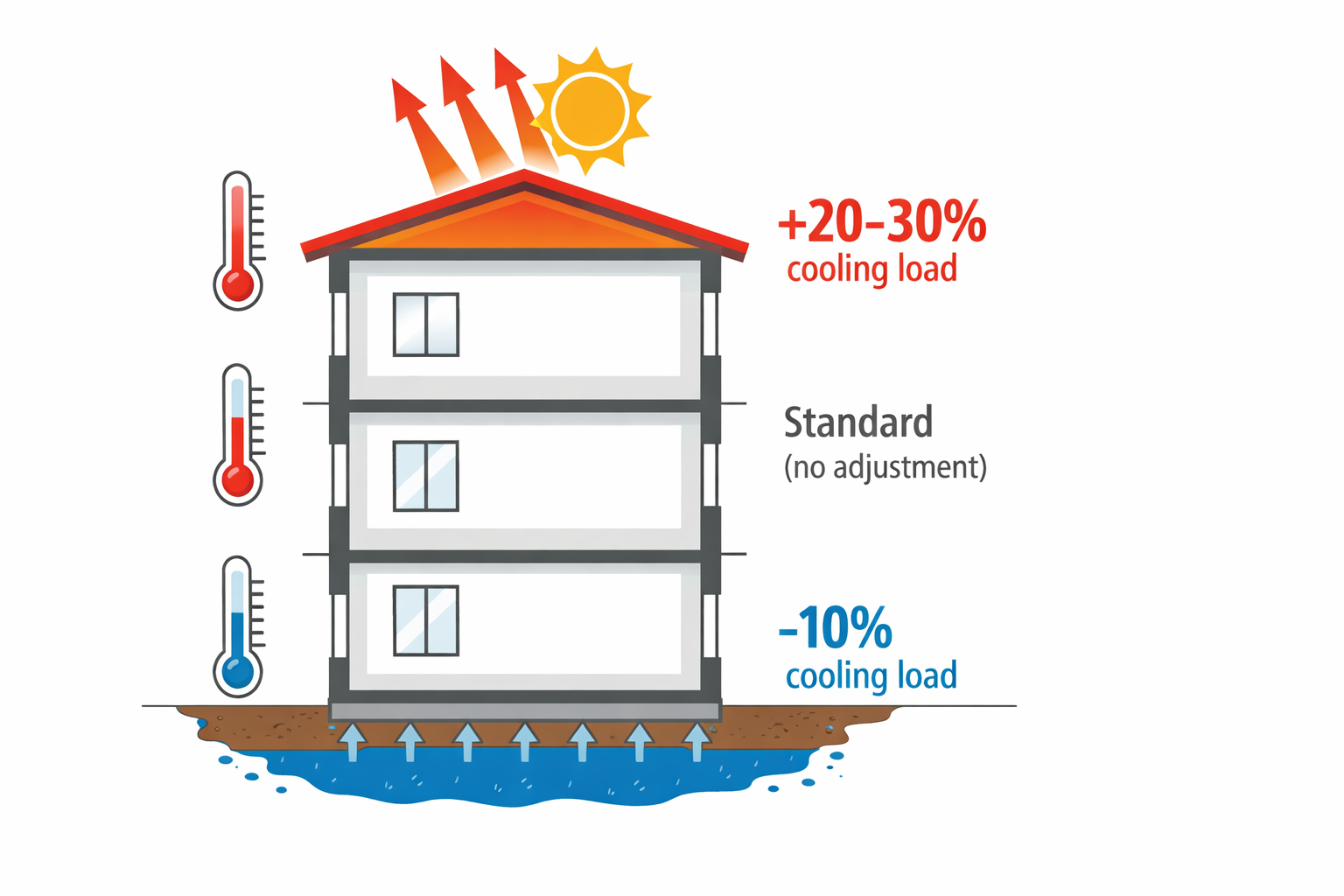
A 150 sq ft top-floor bedroom normally calls for 1.5 ton. Roof heat pushes it into 2-ton territory. If 1.5 ton is all your budget allows, a false ceiling over the AC area helps a lot.
Window direction
Which way your windows face decides how much sun heat enters during the day.
| Window Direction | Heat Impact | Adjustment |
|---|---|---|
| North-facing | Minimal direct sun | No adjustment |
| East-facing | Morning sun, cooler | +5–10% |
| South-facing | Steady sun all day | +10–15% |
| West-facing | Intense afternoon sun | +15–25% (size up if borderline) |
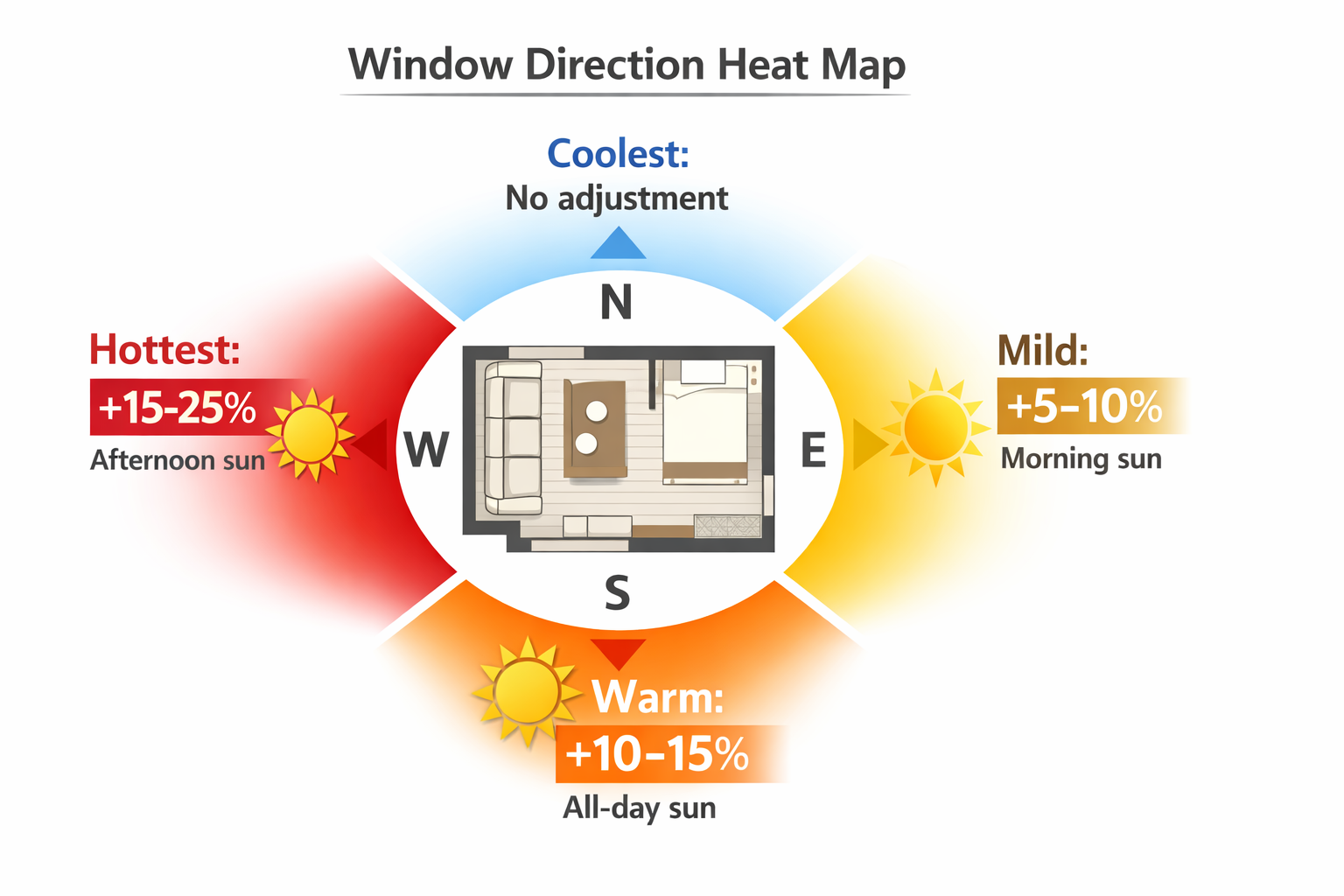
Big windows amplify all of this. Floor-to-ceiling glass on a west wall is the worst case. Curtains or blinds cut the impact by 30–50%.
Corner rooms get hit twice. West plus south windows means sizing up 0.5 ton if you are already near the top of your bracket.
Ceiling height
The charts above assume the standard 10-foot Indian apartment ceiling.
| Ceiling Height | Adjustment |
|---|---|
| 9 feet (older apartments) | -5% |
| 10 feet (standard) | No adjustment |
| 11–12 feet (premium apartments) | +10–15% |
| 14+ feet (bungalows, old buildings) | +20–30% (or size up 0.5 ton) |
Volume matters more than floor area. A 150 sq ft room with a 14-foot ceiling holds 40% more air than the same room at 10 feet.
Climate zone
The charts assume 35°C outside. Cities that run hotter need more capacity.
| Climate | Cities | Adjustment |
|---|---|---|
| Extreme heat (45°C+) | Nagpur, Jaipur, Delhi (May–June), Ahmedabad | +15–20% |
| Hot (38–44°C) | Hyderabad, Lucknow, Bhopal, Pune in summer | +5–10% |
| Moderate (32–37°C) | Mumbai, Chennai, Bangalore, Kolkata | No adjustment |
| Mild (below 32°C) | Hill stations, Northeast India | -10% |
Humidity cuts both ways. Mumbai, Chennai and Kolkata make the AC work harder to dehumidify. But they never hit extreme temperatures, so the two effects roughly cancel out.
Put it together
Take your base tonnage from the room-size chart, then adjust.
| Factor | Adjustment |
|---|---|
| Top floor | +0.5 ton |
| West-facing large windows | +0.25 ton |
| South-facing large windows | +0.15 ton |
| High ceiling (12+ feet) | +0.25 ton |
| Extreme heat city (45°C+) | +0.25 ton |
| Well-insulated, curtained room | -0.25 ton |
| Ground floor | -0.15 ton |
| Runs mainly at night | -0.25 ton |
Round the result to the nearest size sold: 0.8, 1.0, 1.5 or 2.0 ton.
Standard bedroom. 150 sq ft, middle floor, east-facing, 10-foot ceiling, Bangalore. Base 1.5 ton, no adjustments. Buy 1.5 ton.
Top-floor master bedroom in Delhi. 170 sq ft, west-facing, 45°C summers. Base 1.5, plus 0.5 for the floor, plus 0.25 for the window, plus 0.25 for the heat. That lands at 2.5 ton. Buy 2 ton and fit good curtains, since 2.5 ton units are rare.
Ground-floor study. 100 sq ft, north-facing, well insulated, night use only. Base 1.0, minus 0.55 across three factors. Buy 0.8 ton, available from select brands.
Between two sizes, go up
Landing between 1.0 and 1.5 ton? Take 1.5. Between 1.5 and 2.0? Take 2.
An oversized inverter AC costs you very little. The compressor simply runs slower. An undersized AC costs you every single month, in bills and in comfort.
The exception is narrow. A well-insulated, curtained room, used mainly at night, in a moderate-climate city can take the lower tonnage at a 5-star rating.
2. Star Rating — What 3-Star vs 5-Star Really Costs
A 5-star 1.5 ton AC runs ₹38,000–48,000. The 3-star version of the same model runs ₹30,000–38,000. Call the premium ₹8,000–12,000.
Whether that is worth paying depends on one thing: how many hours a day you actually run it.
What the rating measures
BEE ratings are based on ISEER — the Indian Seasonal Energy Efficiency Ratio. It measures cooling delivered per watt consumed, averaged across a full Indian summer.
| Star Rating | ISEER (2025-26 norms) | What It Means |
|---|---|---|
| 1 Star | 3.30–3.49 | Barely legal. Rarely sold. |
| 2 Star | 3.50–3.99 | Budget tier. High running costs. |
| 3 Star | 4.00–4.49 | Mid-range. Good for moderate use. |
| 4 Star | 4.50–4.64 | Uncommon. Few models target it. |
| 5 Star | 4.65+ | Maximum efficiency, lowest bills. |
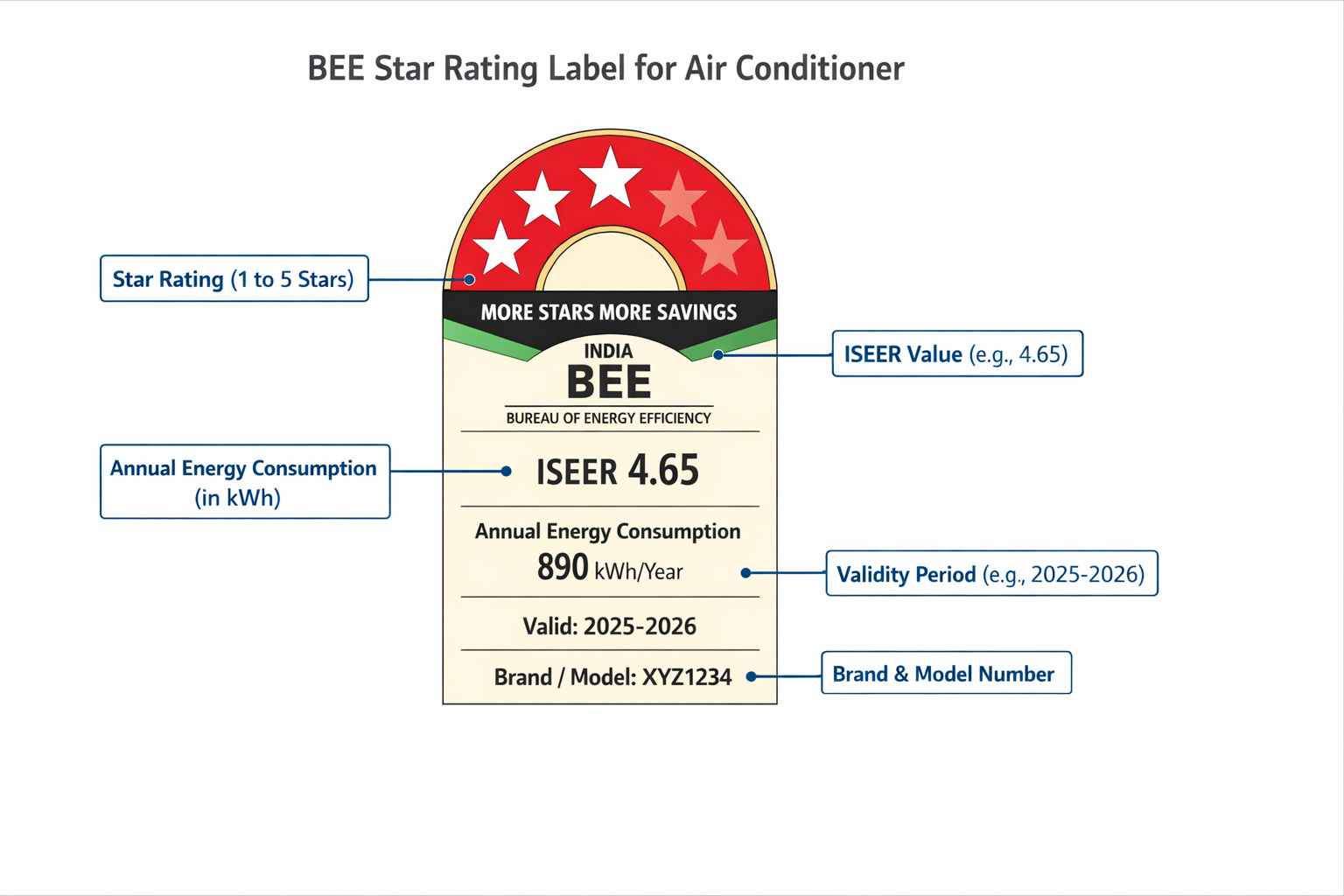
BEE raises these thresholds every two to three years. A 5-star AC from 2023 may only rate 3-star today. The sticker looks the same; the standard moved underneath it.
Always check the validity period printed on the label. It should read 2026 or later.
The monthly maths
At ₹8 per unit, for a 1.5 ton inverter split:
| Daily Usage | 3-Star Monthly | 5-Star Monthly | Monthly Saving | Per Season (5 months) |
|---|---|---|---|---|
| 4 hours/day | ₹1,050 | ₹750 | ₹300 | ₹1,500 |
| 6 hours/day | ₹1,575 | ₹1,125 | ₹450 | ₹2,250 |
| 8 hours/day | ₹2,100 | ₹1,500 | ₹600 | ₹3,000 |
| 10 hours/day | ₹2,625 | ₹1,875 | ₹750 | ₹3,750 |
| 12 hours/day | ₹3,150 | ₹2,250 | ₹900 | ₹4,500 |
| 16 hours/day | ₹4,200 | ₹3,000 | ₹1,200 | ₹6,000 |
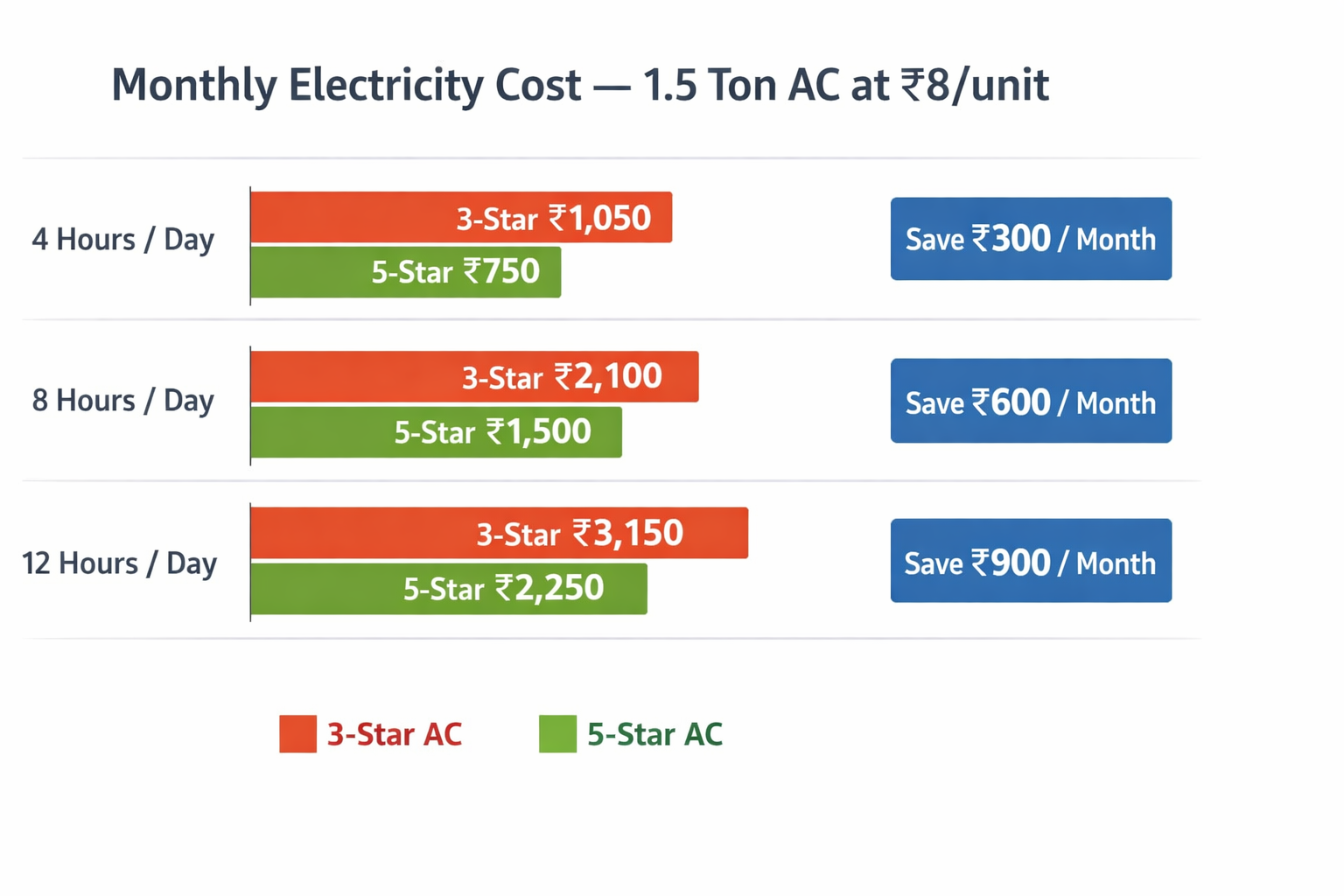
Rates vary by state. Mumbai reaches ₹9–12 per unit at higher slabs; Goa sits at ₹4–5. Higher rates make 5-star more attractive, not less.
For other tonnages, same assumptions:
| Daily Usage | 1 Ton 3-Star | 1 Ton 5-Star | 2 Ton 3-Star | 2 Ton 5-Star |
|---|---|---|---|---|
| 4 hours/day | ₹700 | ₹500 | ₹1,400 | ₹1,000 |
| 6 hours/day | ₹1,050 | ₹750 | ₹2,100 | ₹1,500 |
| 8 hours/day | ₹1,400 | ₹1,000 | ₹2,800 | ₹2,000 |
| 10 hours/day | ₹1,750 | ₹1,250 | ₹3,500 | ₹2,500 |
| 12 hours/day | ₹2,100 | ₹1,500 | ₹4,200 | ₹3,000 |
Three things push your real bill above these numbers. Every degree below 24°C adds 4–6%. A top-floor or west-facing room adds 20–30%. Dirty filters add 5–20%.
A non-inverter AC of the same tonnage costs roughly 25–35% more to run than the 5-star figures above.
When the premium pays off
| Daily Usage | Break-Even (₹10,000 premium) |
|---|---|
| 4 hours/day | 6–7 summers |
| 6 hours/day | 4–5 summers |
| 8 hours/day | 3–4 summers |
| 10 hours/day | 2–3 summers |
| 12+ hours/day | 1–2 summers |
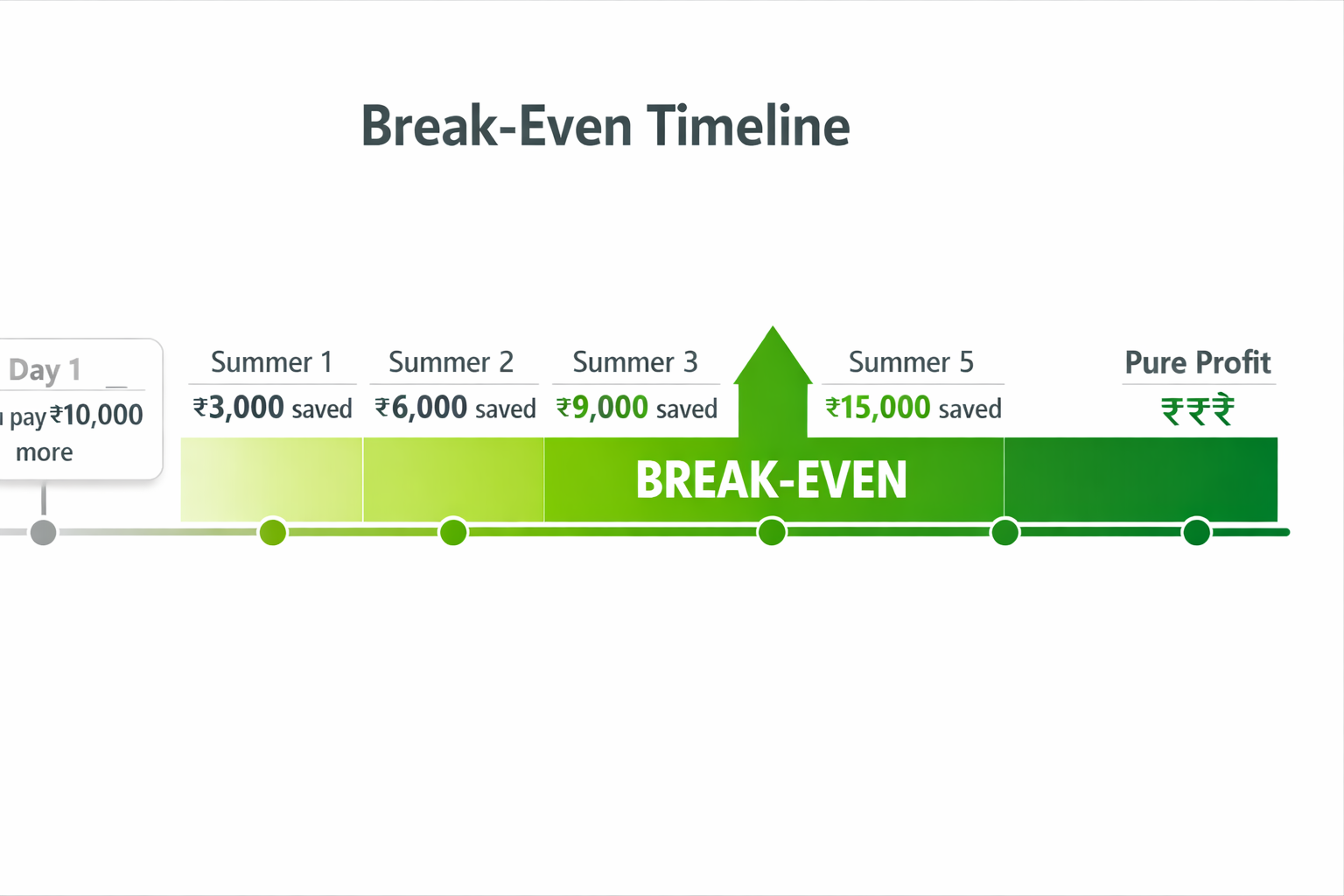
8+ hours a day, 5+ months a year — buy 5-star. It pays back inside three summers and saves ₹30,000–60,000 across its life.
6–8 hours a day — buy 5-star if the upfront cost is manageable. Break-even lands at four to five summers, well inside the AC's lifespan.
4–6 hours a day — 3-star is better value. Break-even stretches past six years, by which point you may have replaced the unit.
Under 4 hours a day, or a guest room — buy 3-star. You will never run it enough to recover the premium.
The slab-rate effect most people miss
Indian electricity billing is progressive. The more you use, the higher the rate on every extra unit.
Take a typical state tariff: ₹4 up to 100 units, ₹6 to 200, ₹8 to 300, ₹10 above that.
A 3-star AC pulling 300 units a month can push your whole household into the top slab. That raises the rate on your fridge, lights and fans too.
A 5-star pulling 200 units keeps you a slab lower. In Maharashtra, Karnataka and Tamil Nadu, this effect can double the real saving.
What about 4-star?
Few brands bother. The build cost between 4-star and 5-star is small, so most skip straight from 3-star value models to 5-star premium ones.
If you find a 4-star priced well below the 5-star equivalents, it is a fair middle ground. Just do not go hunting for one.
Tonnage beats star rating
Facing a choice between right tonnage at 3-star and wrong tonnage at 5-star? Take the right tonnage, every time.
A 1-ton 5-star in a 170 sq ft room runs at full capacity constantly. That wipes out its efficiency advantage. A 1.5-ton 3-star in the same room cycles normally and costs less to run.
Cutting the bill, whichever rating you buy
- Set 24–26°C, not 18–20°C. Every degree above 24°C saves 4–6%. A ceiling fan closes the comfort gap.
- Use the timer. Switch off an hour or two before you wake. The room holds its temperature for 30–60 minutes.
- Clean the filters fortnightly. Clogged filters add 5–15% to consumption.
- Seal gaps, draw curtains. A gap under the door bleeds cool air all night.
- Service once a year. A ₹500–800 service holds rated efficiency. Skip it and you drift 15–20% higher by year three.
3. Split AC vs Window AC
Split ACs are over 80% of Indian sales. Window ACs still sell in millions, mostly in tier-2 cities and rentals.
Cooling — split wins, but by less than you think
Same tonnage means same cooling capacity. A 1.5 ton window AC and a 1.5 ton split both move the same heat.
The difference is efficiency and air distribution. Splits mount centrally and throw air across the room. Window units cool from one corner, leaving warm pockets.
Splits also come with inverter compressors as standard. Most window models are still fixed-speed, which is where the running-cost gap comes from.
Window ACs handle rooms up to about 120 sq ft well. Beyond that, or above six hours a day, the split is the better machine.
Installation — the factor most people underestimate
| Factor | Window AC | Split AC |
|---|---|---|
| Installation time | 30 minutes | 2–4 hours |
| Installation cost | ₹500–1,000 | ₹2,000–5,000 |
| Relocation cost | ₹500–1,000 | ₹2,000–4,000 |
| Wall drilling | No | Yes |
| Outdoor unit | Self-contained | Separate, on wall or ground |
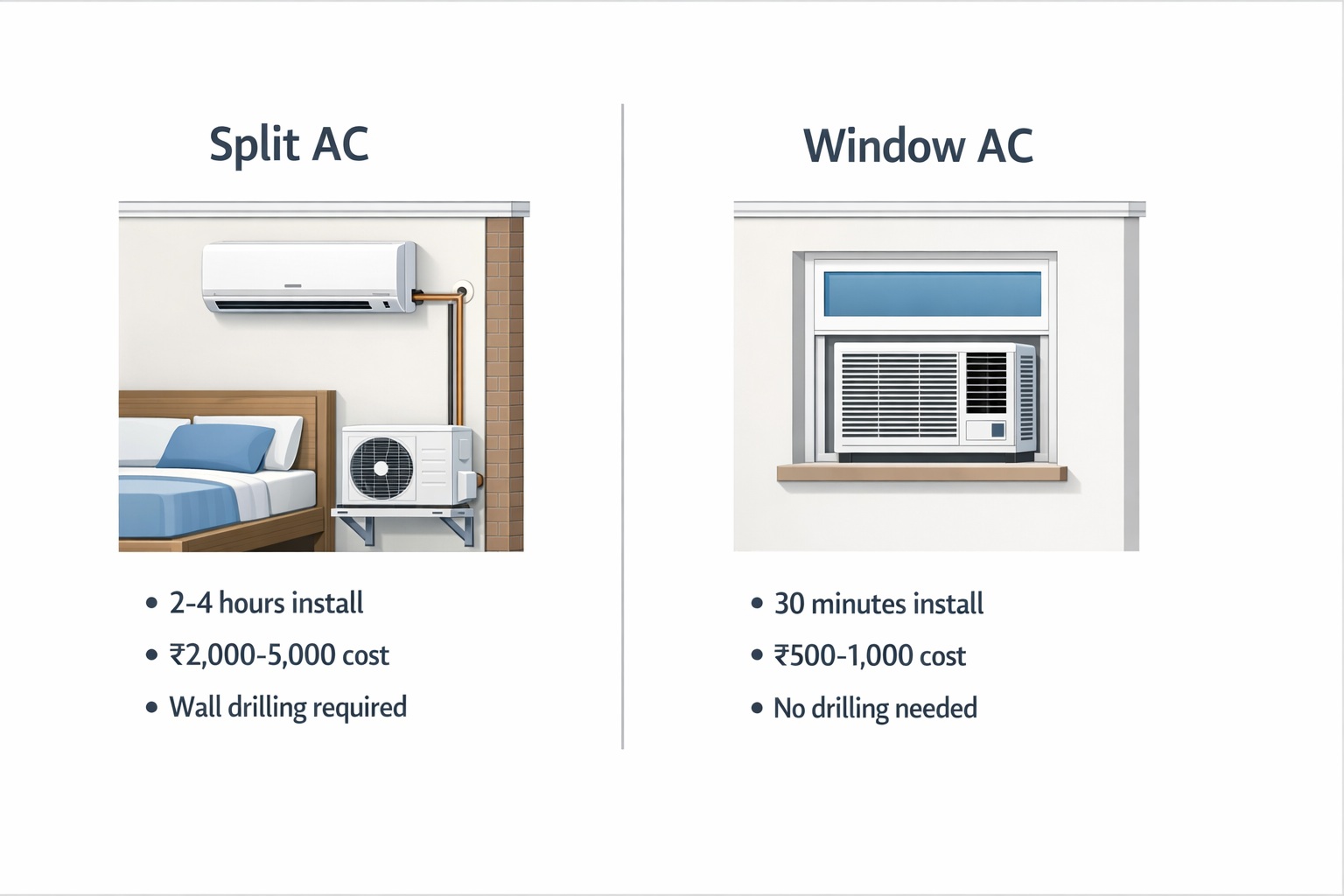
A window unit slides into a standard window opening. No drilling, no piping, no outdoor bracket. You can move it yourself.
A split needs core cutting, a bracket, and copper piping. Three metres come included; extra runs ₹500–800 per metre.
Renters should do the relocation maths. Moving a split costs ₹4,000–8,000 in uninstall plus reinstall. Three moves and that is ₹12,000–24,000 — more than a decent window AC.
Noise
A window AC puts the compressor in the room with you. Indoor noise sits at 48–55 dB, about the level of normal conversation.
A split keeps the compressor outside. The indoor unit runs at 26–36 dB on low fan.
| Window AC | Split (Indoor) | Split (Outdoor) | |
|---|---|---|---|
| Noise level | 48–55 dB | 26–36 dB | 50–55 dB |
| Comparable to | Normal conversation | Quiet library | Window AC |
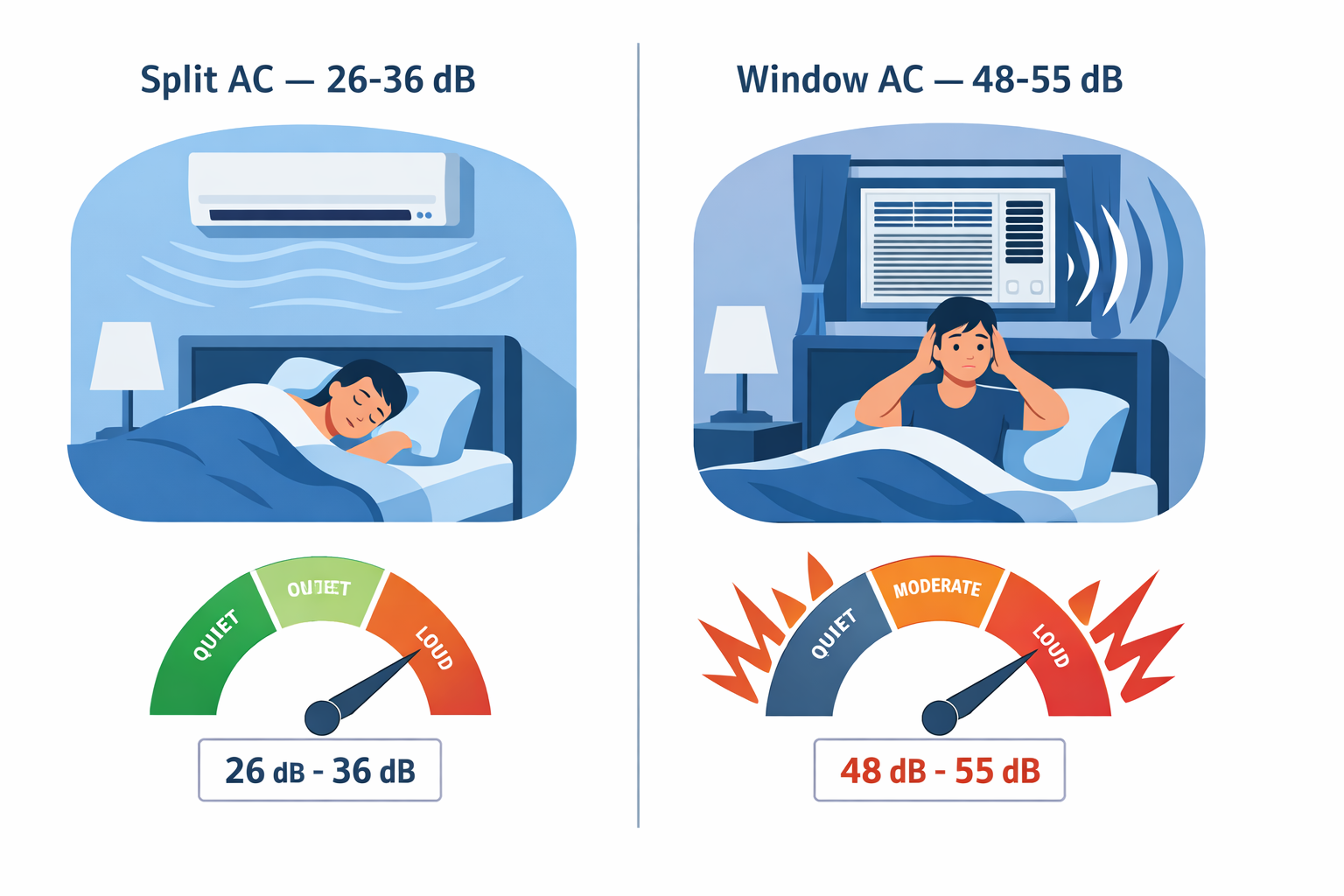
For a bedroom this usually settles the argument. For a kitchen or an occasional guest room it matters far less.
Three-year total cost
Sticker price misleads. Here is the full picture for 1.5 ton over three years.
| Cost Component | Window (non-inverter) | Split (3-star inverter) | Split (5-star inverter) |
|---|---|---|---|
| Purchase price | ₹22,000–28,000 | ₹30,000–38,000 | ₹38,000–48,000 |
| Installation | ₹500–1,000 | ₹3,000–5,000 | ₹3,000–5,000 |
| Monthly electricity | ₹2,800–3,400 | ₹2,100–2,500 | ₹1,500–1,900 |
| 3-year electricity | ₹42,000–51,000 | ₹31,500–37,500 | ₹22,500–28,500 |
| 3-year total | ₹64,500–80,000 | ₹64,500–80,500 | ₹63,500–81,500 |
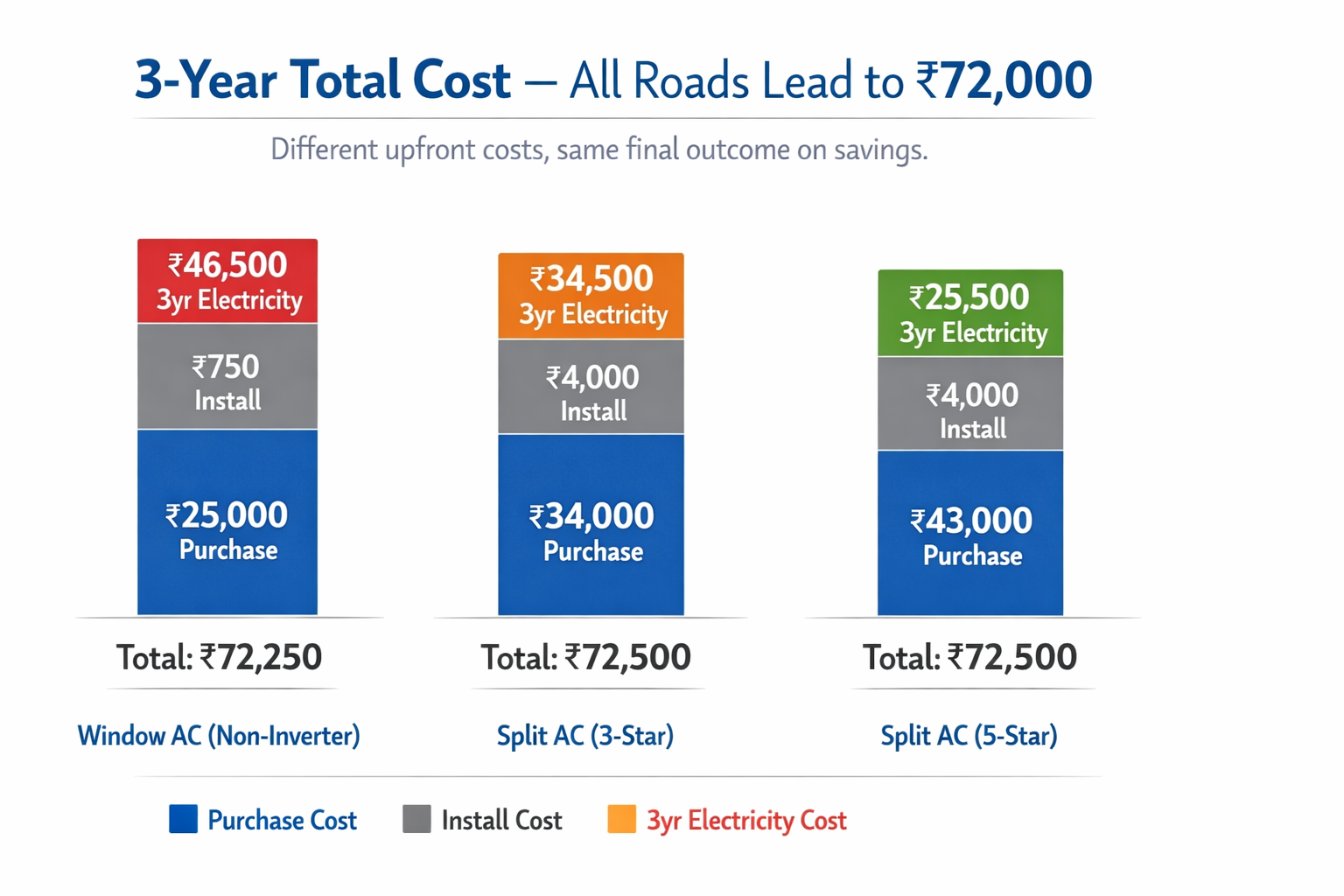
At three years all three land in the same place. The window AC's lower price is eaten by its electricity use.
Past five years the split pulls clearly ahead, and the 5-star split most of all.
Space, looks and repairs
A window unit blocks a window, cutting light and ventilation. Modern sliding aluminium windows often cannot take one at all. Measure before you buy: you need at least 22 inches wide by 16 inches high.
Window ACs are simpler machines and cheaper to fix, at ₹1,000–3,000 for common faults. Any technician can service one.
Splits have more to go wrong — the refrigerant line, the control board, the inverter circuit. Repairs run ₹2,000–6,000. The compressor itself usually carries a 10-year warranty.
Gas refilling costs ₹1,500–2,500 either way.
4. Condenser — Copper, Aluminium and the Coating
The condenser sits in the outdoor unit and dumps your room's heat outside. Brands charge ₹2,000–4,000 extra for copper.
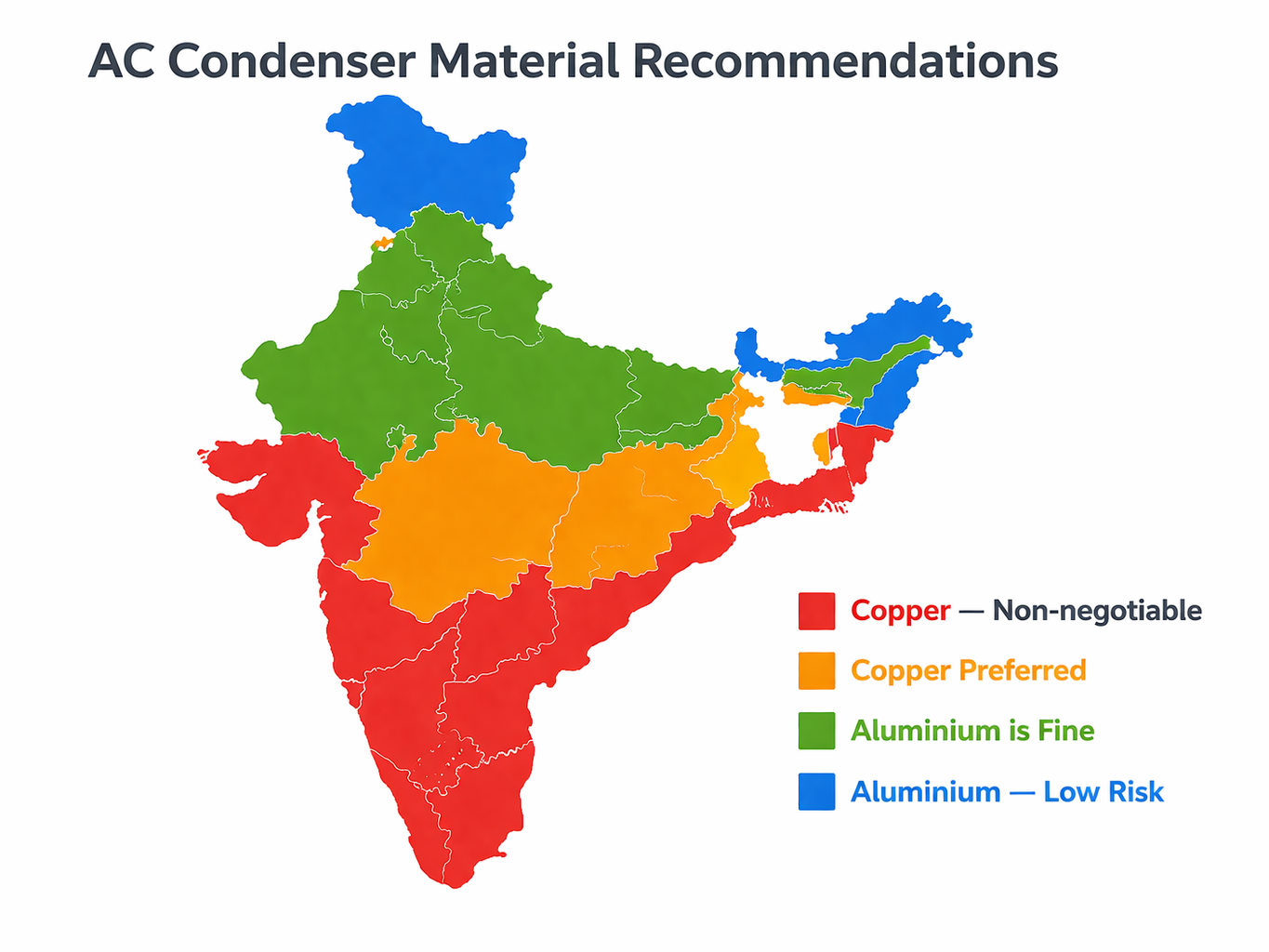
This is a geography decision, not a performance one. Within 50 km of the coast, buy copper. In a dry inland city, aluminium is fine.
Heat transfer is not the reason
Copper conducts heat 60% better than aluminium. That sounds decisive. It is not.
| Property | Copper | Aluminium |
|---|---|---|
| Thermal conductivity | 385 W/mK | 237 W/mK |
| Heat transfer efficiency | Baseline | 20–30% lower |
| Impact on your bill | — | 3–5% higher |
Manufacturers compensate with larger coils and more fins. A well-designed aluminium condenser matches copper at the system level.
A 3–5% gap does not justify a ₹3,000 premium on its own.
Corrosion is the reason
Aluminium corrodes fast in salt air, above 70% humidity, and near industrial pollutants.
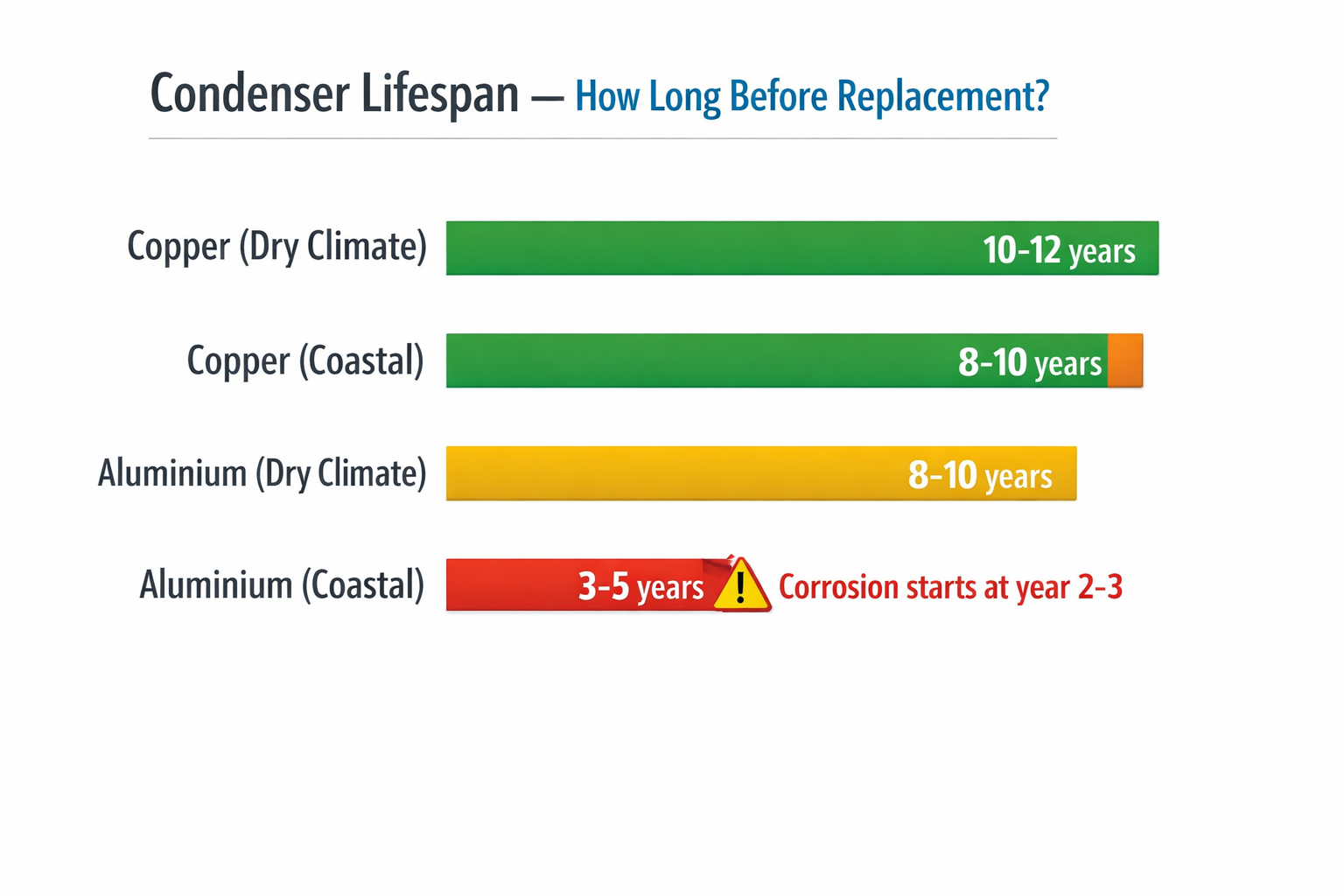
Copper shrugs all of that off. A copper condenser in Mumbai lasts 8–10 years. Aluminium in the same spot shows visible corrosion by year three.
| Climate Zone | Cities | Recommendation |
|---|---|---|
| Coastal | Mumbai, Chennai, Kolkata, Kochi, Vizag, Goa, Mangalore | Copper — non-negotiable |
| Humid inland | Hyderabad, Bhubaneswar, Ahmedabad in monsoon | Copper preferred |
| Dry inland | Delhi, Jaipur, Nagpur, Lucknow, Chandigarh, Pune | Aluminium is fine |
| Hill stations | Shimla, Ooty, cooler parts of Bangalore | Aluminium — low usage, low risk |
Repairability
A leaking copper coil gets soldered on-site in an hour or two, for ₹1,500–3,000.
A leaking aluminium coil usually cannot. Aluminium welding needs equipment most field technicians do not carry, so the fix is a full coil replacement.
| Scenario | Copper | Aluminium |
|---|---|---|
| Minor leak | ₹1,500–3,000 (on-site solder) | ₹8,000–12,000 (full replacement) |
| Major damage | ₹5,000–8,000 (section replacement) | ₹8,000–12,000 (full replacement) |
| Who can fix it | Any local technician | Authorised service centre only |
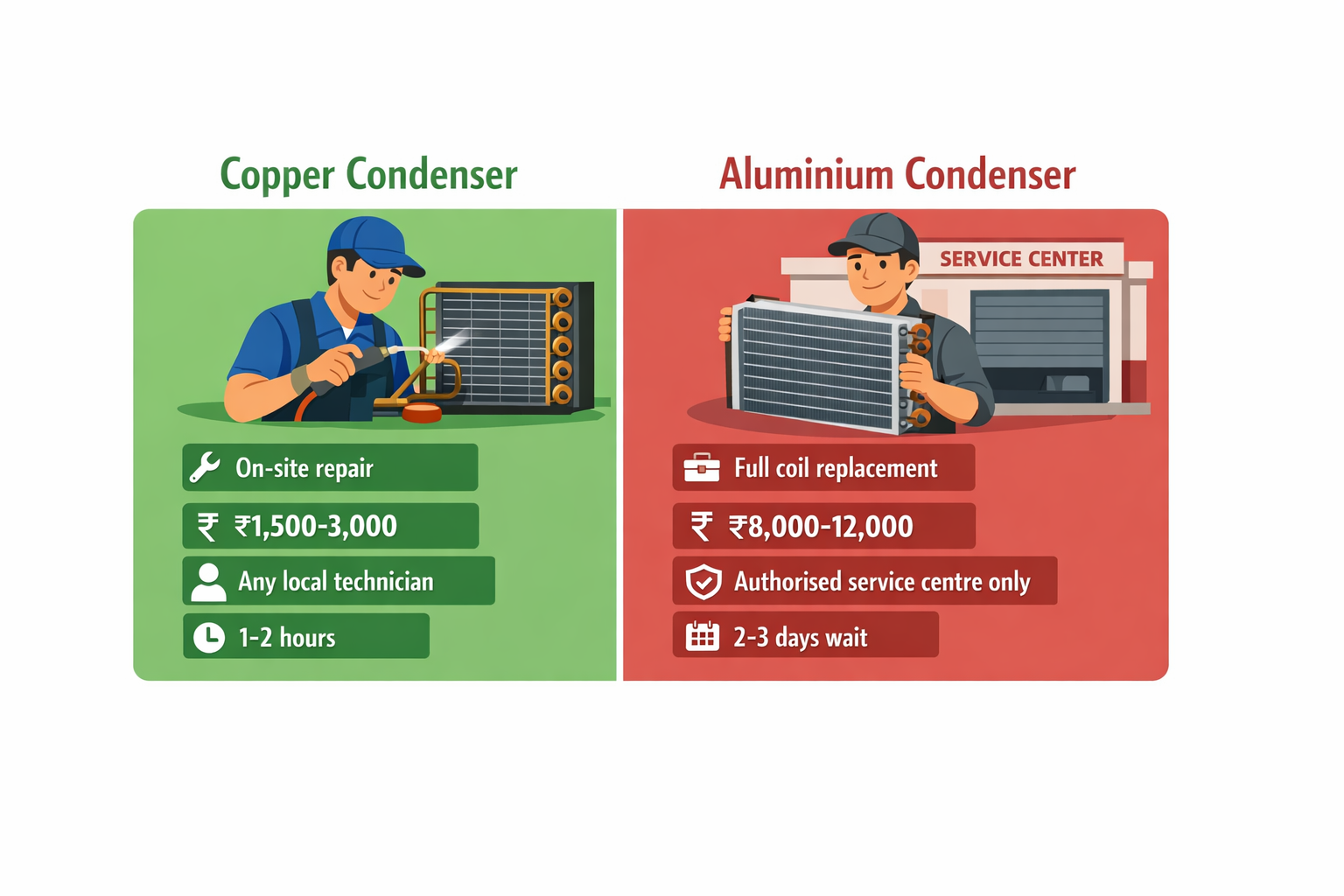
This matters most in tier-2 and tier-3 cities, where the nearest authorised centre may be hours away.
Lifespan
Copper also survives hailstones, stray cricket balls and nesting birds better. Aluminium fins bend easily, and bent fins restrict airflow.
- Copper, dry climate: 10–12 years, trouble-free
- Copper, coastal: 8–10 years, minor repairs after year six
- Aluminium, dry climate: 8–10 years, generally fine
- Aluminium, coastal: 3–5 years before serious corrosion
The coatings, decoded
Blue Fin is an anti-corrosion coating on aluminium fins. It genuinely adds one to two years in humid conditions. Worth having on an aluminium unit.
Gold Fin and hydrophilic coatings help water slide off the fins. A marginal improvement.
Micro Channel condensers use flat aluminium tubes. Better heat transfer than standard aluminium, but still hard to repair.
None of these make aluminium a coastal option. They stretch three years to four or five. Copper still does eight to ten.
On copper units, the coating is the real differentiator:
- Daikin DNNS — from commercial HVAC, strong on coastal air
- Panasonic ShieldBlu+ — layered cover against salt and moisture
- LG Ocean Black Protection — built for salt air and industrial grime
- Blue Star Blue Fin — solid in humid inland cities
Is the premium worth it?
Coastal or humid: the ₹2,000–4,000 premium avoids an ₹8,000–12,000 replacement within four or five years. Buy copper without thinking about it.
Dry inland: aluminium lasts nearly as long. The premium buys you easier repairs, which is nice rather than essential.
5. Inverter vs Non-Inverter — Always Go Inverter
A non-inverter compressor runs flat out, shuts off, then restarts. That means temperature swings, noise spikes and higher bills.
An inverter compressor varies its speed instead, holding a steady temperature.
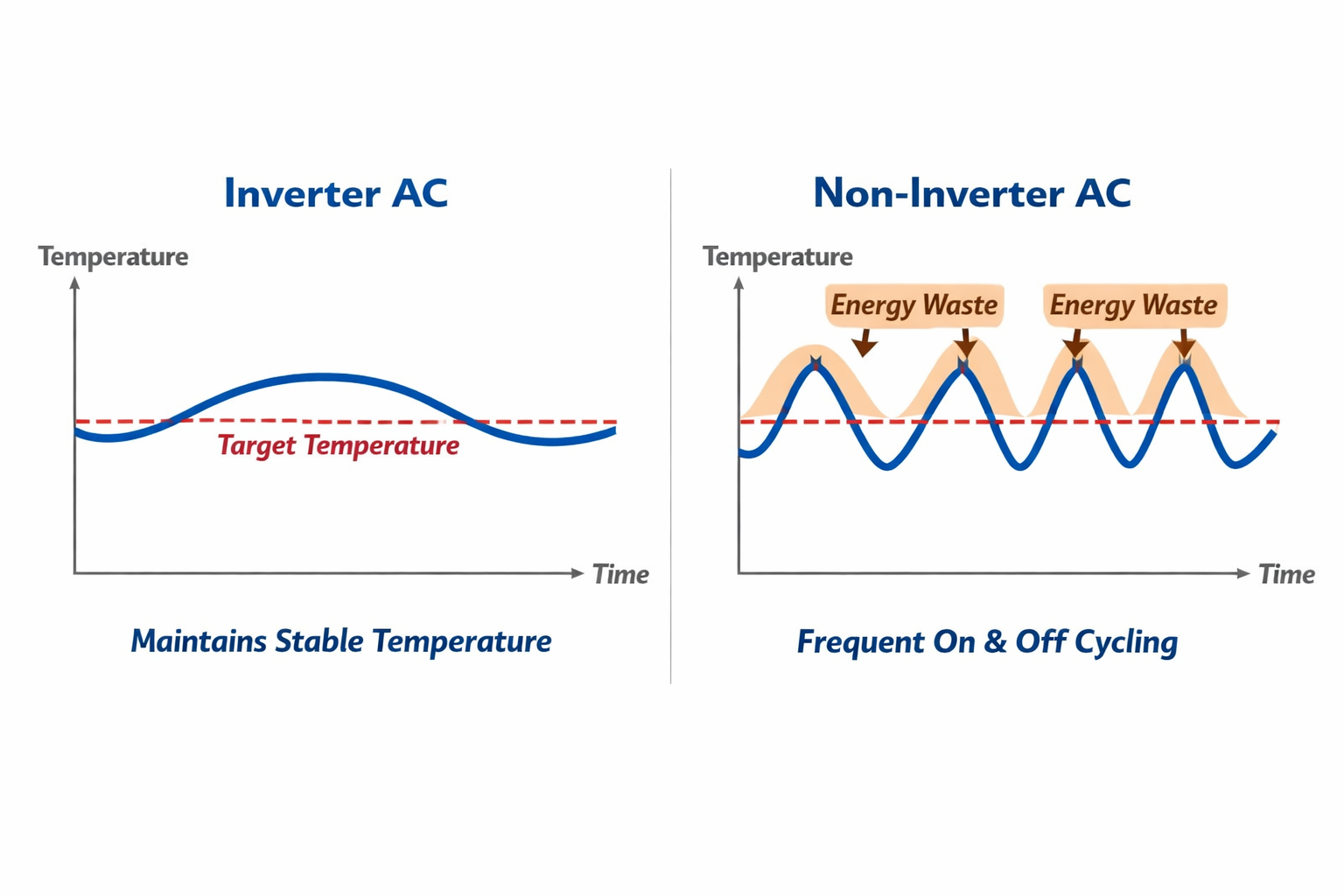
The case is one-sided. Inverters use 30–50% less electricity, run quieter, and last longer under less mechanical stress.
The price gap is now ₹3,000–5,000. You save ₹5,000–7,000 a year on power at normal use. So the gap pays back in the first summer. Buy the inverter.
Inverter vs Non-Inverter — The Full Numbers
Compressor behaviour, the month-by-month electricity comparison, noise levels, and the two narrow cases where a non-inverter still makes sense.
Read the Full Comparison6. Smart Features — Useful, Nice, or Marketing
Worth paying for:
- Convertible tonnage (4-in-1, 5-in-1, 8-in-1). Saves a genuine 10–15% in a small or empty room.
- Self-clean reduces mould on the evaporator and stretches the gap between services. Panasonic's DustBuster also cleans the outdoor unit.
- WiFi control genuinely helps if you want the room cool before you get home. Look for Google Home, Alexa or Matter support.
Nice, but not worth a premium:
- Voice control demos well. In practice the remote is quicker.
- 4-way swing and 3D airflow are a marginal gain over standard 2-way swing.
Ignore entirely:
- "AI cooling" is a thermostat algorithm with a marketing name. Every inverter AC already varies output by temperature.
- PM 2.5 and micro dust filters. An AC is not an air purifier. For clean air, buy a dedicated air purifier.
- Ionizers, vitamin C filters and fancy displays. No measurable effect on cooling or air quality.
Spend on tonnage, star rating and the right condenser. Features come last.
7. Installation — Budget for It Before You Buy
"Free standard installation" covers mounting both units and connecting them with the three metres of piping in the box. Everything else is extra.
| Item | Cost | When You Need It |
|---|---|---|
| Extra copper piping | ₹500–800/metre | Outdoor unit more than 3m away |
| Core cutting | ₹500–1,000 | No existing hole in the wall |
| Outdoor unit stand | ₹500–1,500 | Wall-mount or ground-stand |
| Drain pipe extension | ₹200–400 | Drain must reach a specific outlet |
| Voltage stabiliser | ₹1,500–3,000 | Supply drops below 135V |
Budget ₹2,000–5,000 over the AC price for a split. Most inverter models run safely from 150V to 260V without a stabiliser.
Placement matters:
- Mount the indoor unit 7–8 feet up for even air circulation.
- Never put it directly above electronics. Condensation drips happen.
- Shade the outdoor unit if you can. Direct sun costs 5–10% efficiency.
- Keep the pipe run short. Every extra metre costs you efficiency.
8. Which Brand — Japanese, Korean or Indian?
Japanese — Daikin, Hitachi, Panasonic, Mitsubishi. They make their own compressors, tuned for Indian heat. The Hitachi Tropical Inverter is built for 50°C-plus. Fitters see fewer gas leaks. Compressors last 12–15 years. You pay ₹5,000–10,000 more. Resale value is the best of any tier.
Korean — LG, Samsung. These compete on features and smart tech. LG builds its own compressors and has the widest service network. Strong all-rounders, positioned as feature-rich rather than built-to-last.
Indian — Voltas, Blue Star, Lloyd. These compete on price and reach into tier-3 and tier-4 cities. Voltas leads India on units sold. Blue Star stands out on engineering, carried over from its commercial HVAC business.
Skip the premium for a low-use guest room. Skip it if paying it would force the wrong tonnage. Skip it if you are far from an authorised service centre. Skip it if you plan to replace the unit inside five years.
Right tonnage on an Indian brand beats wrong tonnage on a Japanese one, every time.
9. When to Buy — Prices Rose, But There Are Windows
AC prices have climbed 15–25% since 2024. This is not ordinary inflation.
Tighter BEE norms force better compressors and heat exchangers. Copper is at a ten-year high, and a split AC uses 3–5 kg of it. The R-32 refrigerant switch needed redesigned components. On top of that sits 28% GST and higher duties on imported parts.
These increases are structural. Prices will not fall back to 2023 levels. There is one consolation. A 5-star AC today is far more efficient than a 5-star from 2023.
The best times to buy:
- October to February. Dealers clear inventory with ₹2,000–5,000 discounts.
- Sale events. Republic Day, the Summer Sale and the Great Indian Festival bring genuine 10–20% cuts.
- Last year's models. New lines launch January to March, and the outgoing models get clearance pricing. The performance difference is usually negligible.
Need one now? Buy during the next sale event. Able to wait? October and November are cheapest.
Common Mistakes to Avoid
Oversizing the AC. A 2-ton unit in a 120 sq ft room does not cool faster. It short-cycles, wastes energy and wears out the compressor.
Buying small and "running it longer". An undersized AC never reaches your set temperature. The compressor never rests, the bill maxes out, and the room stays uncomfortable. This is the most expensive mistake on the list.
Measuring carpet area instead of the room. Carpet area includes space under wardrobes and behind bathroom walls. Measure the open floor you are actually cooling.
Forgetting the open kitchen. If the living room opens to the kitchen with no door, you are cooling both. A 200 sq ft living room plus a 60 sq ft kitchen is a 260 sq ft load.
Ignoring heat-generating equipment. A gaming PC throws off 200–500W. Home offices with serious kit need another 0.25–0.5 ton.
Trusting an old star rating. Check whether the BEE label is 2025 or 2026. A "5-star" under old rules may only be 4-star now.
Choosing aluminium on the coast to save ₹3,000. The coil corrodes within four years and replacement costs ₹8,000–12,000. You spend three times what you saved.
Budgeting only for the AC. Split installation runs ₹2,000–5,000 on top. Plan it before you buy, not at the doorstep.
Our Recommended Picks by Room Size
| Your Room | Best Roundup |
|---|---|
| Small bedroom (under 120 sq ft) | Best 1 Ton Split ACs |
| Medium room (120–180 sq ft) | Best 1.5 Ton Split ACs |
| Large room (180–280 sq ft) | Best 2 Ton Split ACs |
| Very large hall (280+ sq ft) | Best 2.5 Ton Split ACs |
| Any room, window slot available | Best Window ACs |
Frequently Asked Questions
A 5-star 1.5 ton inverter AC costs about ₹1,500 a month at 8 hours daily use and ₹8 per unit. The 3-star version of the same model costs about ₹2,100. Your actual bill depends on your state's slab rates, your floor level, and how low you set the temperature.
A 12×15 room is 180 sq ft. Under standard conditions that calls for 1.5 ton. Standard means a middle floor, a 10-foot ceiling, and no harsh afternoon sun. Go up to 2 ton for a top-floor room, large west-facing windows, or a city that hits 45°C.
No. A 3-star inverter AC in 2026 beats a 5-star from 2022 on efficiency. It suits use under 6 hours a day, guest rooms, and tight budgets. Star rating sets running cost, not cooling power. A 3-star cools just as well as a 5-star of the same tonnage.
Not usually. Window ACs cost ₹8,000–15,000 less upfront, but most are fixed-speed and use more electricity. The gap closes within three years and the split pulls ahead after five. A window AC only wins if you use it under 4 hours a day or move house often.
On the coast, yes. Salt air eats aluminium within three to four years. Copper shrugs it off. A new coil costs ₹8,000–12,000. The ₹2,000–4,000 premium pays for itself. This covers Mumbai, Chennai, Kolkata, Kochi and Goa. Inland and dry — Delhi, Jaipur, Nagpur — the cheaper coil is fine.
Most inverter ACs run safely from 150V to 260V. At that range you need no stabiliser. Add one if your supply drops below 135V. Add one too if voltage swings hard in summer. Non-inverter models are more at risk. Their compressor starts at full power. A stabiliser costs ₹1,500–3,000.
Twice a year — once before summer in March, once after the monsoon in October. Clean the indoor filters yourself every two weeks during heavy use. Auto-clean features reduce the need for professional servicing but do not remove it.
ISEER stands for Indian Seasonal Energy Efficiency Ratio. It measures cooling delivered per unit of power. The score covers a whole season, not just peak load. Two ACs can both be 5-star yet differ by 0.5 ISEER. That gap is ₹400–600 a year. Compare ISEER, not just stars.
Ready to Choose? See Our Ranked Picks
We analyse specs, verified owner reviews and live Amazon.in prices to rank the best ACs in every tonnage.
Browse AC Recommendations