Luggage Material Guide India — Polycarbonate vs Polypropylene vs ABS
Luggage material guide for India — polycarbonate vs polypropylene vs ABS vs aluminium, hardside vs softside, and which shell actually survives airport handling.
Two suitcases can look identical on the shelf and cost ₹3,000 apart — and the difference is almost always what the shell is made of. Material is the single decision that drives how much your bag weighs, how much it costs, and whether it cracks the first time a baggage handler drops it. Get it right and everything else is fine-tuning.
This guide explains every luggage material sold in India in plain terms — the three hardside plastics (polypropylene, polycarbonate, ABS), aluminium, and the softside fabrics — so you can match the shell to how you actually travel. We researched and compared how each behaves on price, weight, and real-world impact resistance, drawing on owner reviews and manufacturer specs.
Short answer: for most Indian flyers, quality polypropylene is the best-value luggage material — it flexes and springs back instead of cracking, stays light against the 7 kg cabin limit most Indian airlines set, and costs far less than polycarbonate. Step up to virgin polycarbonate only if you want the premium finish; choose aluminium only for the look if you fly internationally and don't mind the weight; and avoid pure ABS unless you fly rarely and pack light, because it's the most crack-prone shell. Whatever the material, remember that the zippers and wheels usually fail before the shell does — so branded YKK zips matter more than an extra gram of shell premium.
Already know you want a carry-on and just want picks? See our shortlist in Best Cabin Trolley Bags in India (2026). For one or two nights away, the smaller overnighter trolley bags are lighter and hold enough.
Key Decision Factors
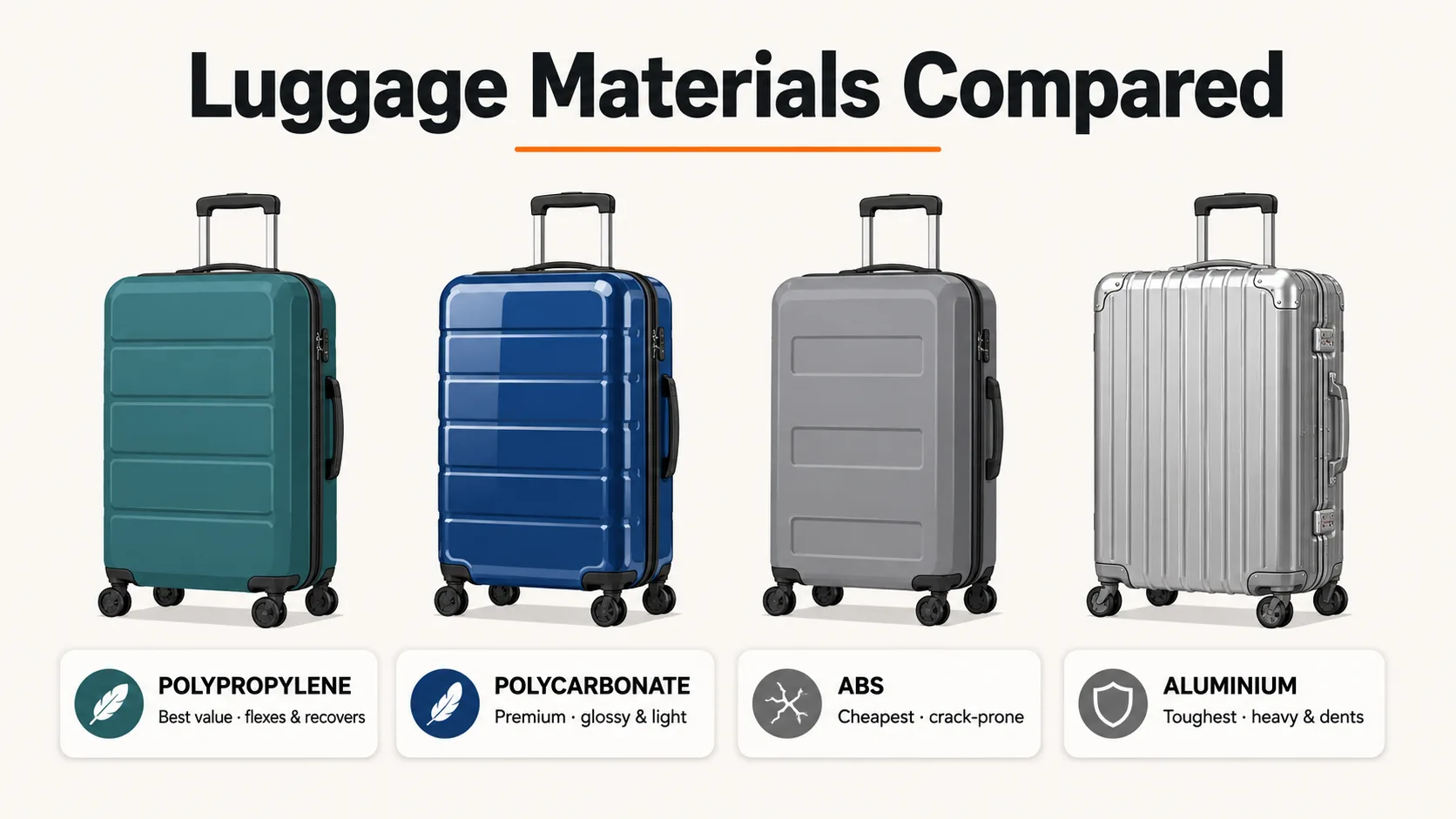
At a glance, here's how the four hardside materials compare — the detailed sections below explain each one.
| Material | Price | Weight | Impact behaviour | Best for |
|---|---|---|---|---|
| Polypropylene (PP) | Budget–mid | Light | Flexes and recovers | Most flyers wanting value + durability |
| Polycarbonate (PC) | Mid–premium | Light | Flexes and recovers (best as virgin PC) | Premium finish; fragile checked contents |
| ABS | Cheapest | Light–medium | Brittle, most crack-prone | Infrequent, gentle, light-duty use |
| Aluminium / Magnesium | Highest | Heaviest | Dents, does not crack | Frequent international flyers wanting a statement case |
Hardside vs Softside — The First Fork
Before you compare plastics, decide whether you want a hard shell at all. Hardside (moulded plastic) protects fragile contents, resists water, and wipes clean — but adds weight and offers zero external storage. Softside (fabric) is lighter, squeezes into tight boot spaces, and gives you grab-and-go outer pockets — at the cost of impact and water protection. Most flyers are better served by hardside today; softside still wins for road trips, gear that needs quick access, and anyone who overpacks and needs a bag that flexes.
| Hardside | Softside | |
|---|---|---|
| Impact protection | Excellent | Fair |
| Water resistance | Excellent | Poor–fair |
| Weight | Heavier | Lighter |
| External pockets | None | Several |
| Best for | Flights, fragile items | Road trips, quick access |
Polypropylene — The Flex-and-Recover Value Champion
Polypropylene (PP) is the material most Indian value hardside bags use, and for good reason: it is light, cheap, and — crucially — it flexes on impact and springs back instead of cracking. That impact behaviour is why premium brands trust it too; Samsonite's Octolite line and DELSEY's Moncey both use PP shells that absorb an airport drop rather than shatter. It looks less glossy than polycarbonate and can feel less premium, but for durability-per-rupee it is the smart default for most travellers. You'll find it across almost every tier in our Best Cabin Trolley Bags in India (2026) roundup.
| Polypropylene | |
|---|---|
| Price | Budget–mid |
| Weight | Light |
| Impact behaviour | Flexes and recovers |
| Look | Matte, less premium |
| Best for | Most flyers wanting value + durability |
Polycarbonate — The Premium Hardside
Polycarbonate (PC) is the premium hardside material. Like PP it flexes and returns to shape, but it does so at a higher strength-to-weight ratio, takes a glossier finish, and generally looks and feels more expensive. The catch is that "polycarbonate" is not one thing: virgin polycarbonate (as in Mokobara's German-Makrolon shells) is genuinely tough, while cheaper PC/ABS blends dilute it to hit a price. Watch for this — a few budget "polycarbonate" bags draw owner reports of the shell cracking on early flights, so the brand and whether it's virgin PC matter more than the label. When it's the real thing, PC is the best hardside you can buy. See how it plays out across full sets in Best Trolley Bags & Luggage Sets in India (2026).
| Polycarbonate | |
|---|---|
| Price | Mid–premium |
| Weight | Light |
| Impact behaviour | Flexes and recovers (best when virgin PC) |
| Look | Glossy, premium |
| Watch for | PC/ABS blends sold as "polycarbonate" |
ABS — The Budget, Crack-Prone Shell
ABS is the cheapest hardside plastic, and it shows. It is more brittle than PP or PC, so it is the material most likely to crack or split under a hard drop — the recurring "thin plastic" complaint in budget-luggage reviews is almost always ABS. It is acceptable if you fly rarely, keep the bag light, and treat it gently, but if you can stretch even slightly, pay up for polypropylene over pure ABS. Many bags marketed as hardside at the lowest price points are ABS or ABS-heavy blends — read the material spec, not just the "hardshell" label.
| ABS | |
|---|---|
| Price | Cheapest |
| Weight | Light–medium |
| Impact behaviour | Brittle, most crack-prone |
| Best for | Infrequent, gentle, light-duty use |
Aluminium & Magnesium — The Premium Niche
Aluminium (and magnesium-alloy) shells are the luxury end: extremely rigid, they dent rather than crack, and they carry a lifetime-heirloom feel. But they are heavy — a real problem against a 7 kg cabin limit — expensive, and they show every scuff and ding as a permanent battle scar. For a frequent international traveller who wants a statement case and doesn't mind the weight penalty, they're superb. For the typical Indian domestic flyer weighing every gram and rupee, aluminium is overkill; a good polycarbonate does 90% of the job at a third of the weight and price.
| Aluminium / Magnesium | |
|---|---|
| Price | Highest |
| Weight | Heaviest |
| Impact behaviour | Dents, does not crack |
| Trade-off | Shows every scuff; eats into weight limit |
Softside Fabrics — Nylon vs Polyester & Denier
If you go softside, the fabric — and its denier (a thread-thickness rating, higher = tougher) — is what matters. Nylon, especially ballistic or Cordura nylon, is stronger and more abrasion- and tear-resistant than polyester at the same denier, which is why it costs more. Polyester is cheaper and holds colour well, and most value softside bags use it; a high-denier polyester (600D+) is perfectly durable for regular use. Neither is truly waterproof — look for a water-resistant coating and, ideally, a rain cover if you'll be out in monsoon.
| Nylon (ballistic/Cordura) | Polyester | |
|---|---|---|
| Strength at equal denier | Higher | Lower |
| Abrasion/tear resistance | Excellent | Good |
| Price | Higher | Lower |
| Colour retention | Good | Excellent |
Beyond the Shell — Where Luggage Actually Fails
Here's the honest truth the material debate misses: most bags don't die because the shell fails — they die at the zippers, wheels, and handle. A cracked shell is rare; a split zipper or a seized wheel is common. Prioritise branded YKK zippers, sealed spinner wheels (ideally replaceable), and a solid multi-stage telescopic handle over an extra gram of shell premium. And remember the weight math: on a 7 kg cabin allowance, the empty weight of the bag matters more than which plastic it's made of — a lighter PP bag that leaves you 800 g of packing headroom beats a heavier "premium" shell you can't fill.
Common Mistakes to Avoid
Paying for polycarbonate when weight is the real constraint. On a 7 kg cabin limit, every gram of empty bag is a gram less you can pack. A lighter polypropylene case often makes more practical sense than a heavier premium shell you can't fully load. Weigh the empty bag before you fall for the material.
Assuming "hard shell" automatically means tougher. A cheap ABS hard shell can crack where a good high-denier softside bag simply flexes and survives. "Hardside" is a shape, not a guarantee of durability — the specific material and build quality decide it.
Ignoring the zipper. The shell is rarely the failure point; the zipper is. A ₹5,000 bag with an unbranded zipper is a worse long-term buy than a ₹3,500 one with YKK zips. Check the zipper brand before you check anything else.
Buying pure ABS to save a few hundred rupees. The gap between ABS and polypropylene is often just ₹300–₹500, but the durability gap is large. It's the clearest false economy in luggage — stretch to PP if you possibly can.
Over-buying aluminium for domestic trips. It's heavy, expensive, and scuffs permanently. Unless you specifically want the look and travel internationally, a polycarbonate case gives you most of the toughness without the weight and cost penalty.
Ready to See Our Picks?
Now that you know which shell to look for, see the cabin bags we currently recommend across every material and budget.
See Our Top Cabin Bag PicksFrequently Asked Questions
For everyday toughness-per-rupee, virgin polycarbonate is the strongest mainstream shell, with quality polypropylene close behind because both flex and recover instead of cracking. Aluminium is the most rigid of all — it dents rather than cracks — but it is heavy and expensive. ABS is the least durable and the most crack-prone. Whatever the shell, the zippers and wheels usually fail before the material does.
For checked flights, hardside is usually the better choice — it protects fragile contents and resists rain on the tarmac. Softside is better if you want external pockets for quick access, need to squeeze the bag into tight spaces, or are mostly doing road trips. Either way, prioritise a light empty weight so you keep more of your baggage allowance for actual luggage.
Only if it's genuine virgin polycarbonate and you value the premium finish. Real PC is a touch stronger for its weight and looks glossier, but good polypropylene flexes and survives airport handling just as well for less money. Beware cheap bags labelled 'polycarbonate' that are actually PC/ABS blends — there, polypropylene is the safer buy.
Indirectly — the material sets the empty weight of the bag, and that empty weight eats into your allowance before you pack a thing. Polypropylene and polycarbonate are light; aluminium is heavy. On a 7 kg cabin limit, choosing a lighter shell can buy you an extra half-kilo of packing room.
For cabin bags, favour the lightest durable shell — polypropylene or polycarbonate — because weight is tightly capped. For checked bags, you have a little more weight headroom, so polycarbonate's extra rigidity is worth it for fragile contents, and a tough high-denier softside works well if you want expandability and pockets.
Sources
Airline, government, and standards-body references for the figures and rules cited in this article.
Related Articles
By Naveen Bhavnani, Founder & Reviewer
How we research & rank